Mostrando entradas con la etiqueta Clásicas/classics. Mostrar todas las entradas

sábado, 29 de junio de 2013

Jean Pierre Monsere, a tragic champion.


Jean Pierre Monsere was born  the 8th of September of 1948 in Roeselare, Belgium, and was supposed to be a new Merckx, at least in classics and Worlds, but he had no option.

The fifteenth of March, 1971, he died after being run over by a car while training.


He was a young promise from the same town than another Belgian pro, Patrick Sercu ( who was a superb track rider and a good "pro" rider too) 

Patrick Sercu

 Jempi ( as he was known) turned into "pro" with the mythic Flandria team in 1969, a year when everybody was speaking about Merckx, especially in Belgium.


He had very good perfonmances and won a monument,the " giro de Lombardia", after being disqualified the winner ( positive drug test) Gerben Kaerstens...
Photo:  graziano nardini

And in 1970 he showed a very good condition, winning two stages in the " Vuelta a Andalucía", and good position inspring classics ( 8th in G. Wewelgem, 6th in Flanders, 10th in Paris Roubaix and 8th in Flecha Wallona) and a third position in the Belgian championship, behind Merckx and Van Springel.

But his moment to enter the history of cycling was still to come, in August, in Leicester, where the World championship were held.

It was a flat ciruit, and the favourites were the Italian roders Gimondi and Dancelli, the German Altig, the French Guimard, and the Belgian team with De Vlaeminck, Merckx and Godefroot ( Monsere was just another rider).

There were 270 kilometers, with 18 laps to a flat circuit in a very cloudy and windy day.

Sunday 16th of August, Leicester.

The first laps were relaxed till Merckx started to accelerate in the 4th lap.


Then was time to attacks and counterattacks, and after a hard fight the Italian team took the control with dangerous attacks involving Dancelli, Motta and Gimondi, and in the 10th lap a very dangerous breakaway was formed, withou Merckx ... but with Monsere.

Time was passing , with advantages from 30" to 2 minutes for the breakaway. And in the 13th lap,not happy with the gap, another attack of Gimondi selected the race definitily.

Gimondi, Vasseur, Mortensen, Monsere,Roussel and West were going to fight for the rainbow. Behind them things were not clear and Gimondi´s effort made the breakaway possible. With a lap to go the gap was a minute.

An angry Gimondi was leading the front grou with no help


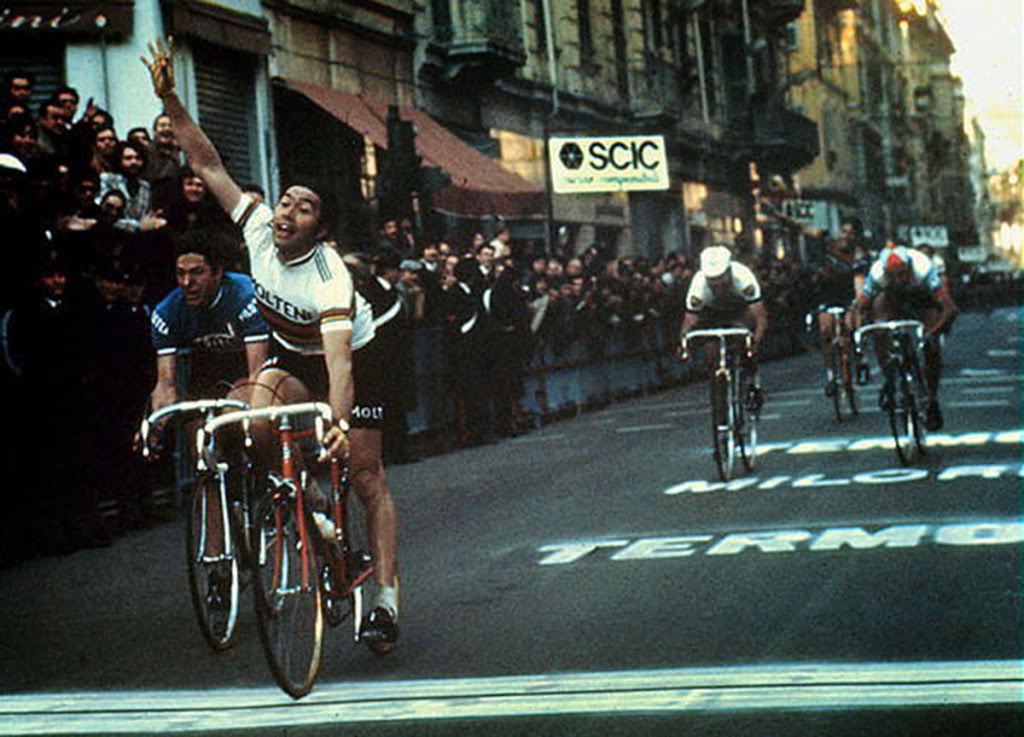
And Monsere took his moment with two kilometers left. He attacked and there was no reaction. There was a new world champion


Mortensen was now reacting and sprinting, but only for second...


He was the second youngest world champion after another Belgian, Karel Kaers, in 1934.

Joy for Monsere, dissapointment for an angry Gimondi who was accused by Monsere, who said the Italian tried to buy him.

Merckx finally just could be 29th, and de Vlaeminck 8th.

1º.Jean Pierre Monsere........6h33'58" 
2º.Leif Mortensen....................a 2"     
3º.Felice Gimondi..................a 2"  
4º.West.....................................a 3"
5º.Roussel.................................a 5"
6º.Vasseur.................................a 9"
7º.Godefroot..............................a 18"

Great for Monsere


Now he was one of the greats, and in 1971 he started strong, winning the Vuelta of Andalucia


But tragedy was going to break the career of this Belgian talent.

The fifteenth of March, Monsere died while riding  ...


The funeral was incredible and very moving ...


De Vlaeminck was devastated, Zoetemelk could not hel the emotion, and merckx just asked to reporters to leave him alone ... even Gimondi said that he was a true champion.


during the 1971 season , there were homages in honour of Jempi ...


Spruyt , Ocaña , Sweert , Merckx , Janssen  y Gosta Petterson

But tragedy pursued Monsere´s family and 5 years later his 7 year-old son Giovani died after crashing with his bycicle to a vehicle, Giovani´s bike was a present of another champion, Freddy Maertens.

Maertens could never recover from these two tragedies, so when he won his two Worlds, in 1976 and 1981, they were dedicated to Monsere and Giovanni


1976 Worlds.Ostuni,Italy.Maertens first,Moser, second, Conti third
x

1981Worlds, Praga.With Saronni and Hinault.

An emotive story for one of the talents that could not show all his potential.

Miss you Jempi.

miércoles, 17 de abril de 2013

Sean Kelly, un mito sin Flandes.

Sean Kelly, irlandés nacido en el año 1956, y que militó en sus inicios en el mítico Flandria Velda, de la mano de otro mito de éste deporte, Jean de Gribaldy, compartiendo equipo con la figura del momento Freddy Maertens y con otros como el controvertido Michel Pollentier.


Foto flickrhivemind.net


Éste tozudo irlandés amasaría un palmarés como sólo los más grandes, y llegó a dar momentos estelares en las clásicas ( años 84 y 86) como no se vivían desde los tiempos de Merckx.

Consiguió todo lo que quiso, salvo tres cosas. El mundial, que le parecía esquivo incluso en ocasiones en que parecía máximo favorito ( 1987 o 1989) llegado al final de la prueba, fué uno.

El Tour de Francia siempre fué un pequeño lunar en su trayectoria puesto que aunque se empeño en conseguir un podium y soñaba con un triunfo, lo más cerca que estuvo fué en la edición del 85 en la que fué 4º. Si bien fué protagonista en varias ediciones y logró cuatro maillots de la regularidad. Se da también la curiosidad de que el irlandés que consiguió 5 victorias de etapa en sus Tours, no logró ninguna de estas a partir de 1983, siendo tres de sus maillots verdes conseguidos sin lograr ninguna victoria de etapa, quedándose a las puertas en incontables ocasiones.

Sin embargo el lastre a su generoso curriculum ( Vuelta a España 1988, San Remo, Roubaix, Lieja, Lombardía, record de victorias en Paris Niza, Volta, Criterium, etc) fué sin duda el Tour de Flandes. él estaba destinado a ser el primer no belga en conseguir los 5 monumentos y estuvo realmente cerca. Lo mereció, pero no pudo ser.

Sus años gloriosos 84 y 86, en los que consiguió ganar Roubaix por dos veces


Foto  www.parisroubaixchallenge.fr


y Lieja y San Remo en una ocasión (1984 y  1986 respectivamente), vieron como daba al poste en ambas ocasiones en Flandes. Volviendo a quedar segundo en el 87.

Foto worldwidecyclesblog.com


Tuvo el doblete Roubaix-Flandes a tiro en ambas temporadas, pero Lammerts y sobretodo Adrie Van der Poel en un esprint de infarto en el 86, acabaron con su sueño.

Legaban al último kilómetro Van der Poel, Vandenbrande, Kelly y Bauer, con el grupo seguidor a medio minuto, en una Flandes que había visto a un buen Lemond dando guerra hasta casi el final. Sin embargo la victoria iba a ser para los cuatro de alante, y el belga del Kwantum arrancaba de forma potente para dejar con la miel en los labios a Kelly y consiguiendo quizás la victoria más importante de su carrera deportiva.

Foto  www.stevenverhelst.nl


Da igual que no pudiera completar los 5 monumentos, Kelly es un grande, siempre ha sido y será una referencia en éste deporte, pero en aquellos años 80 estuvo cerca de completar un genial palmarés y no lo logró.

Quizás era la suya, ese Flandes del 86, parecía ser el favorito en el esprint, pero un corredor de clase y de momentos de inspiración como Van der Poel le privaron de la victoria, una victoria que Kelly consiguió en el corazón de todos los amantes del ciclismo. Nadie dijo que sería fácil, y aunque durante años lo intentó, no pudo. Aún así, le agradecemos todos esos años de profesionalidad y entrega y soñamos con que salga un corredor que se le parezca ( Jalabert en determinados aspecto y Valverde en otros son ciclistas que han tenido cierta similitud, pero no en las piedras, y ahí queremos ver a su suceso también , ¿ quizás Sagan?, a lo mejor, aunque no en su forma de ser ...).

Thanks Sean

domingo, 30 de diciembre de 2012

Milano San Remo. Merckx´s kingdom. Part III.

1973 and 1974 were very good years for Merckx, who completed his great career with the Vuelta 73, and with an amazing triple crown ( Giro,Tour and Worlds) in 1974.

Coincidentally he didn´t win in Via Roma those years. Roger de Vlaeminck won his first San Remo in 1973 and Gimondi his only one in 1974,with the rainbow jersey


De Vlaeminck wins in Via Roma in 1973      Photo http://www.gios.it


Milano San Remo 1974 Photo: Courtesy Marcel Segessemann


Two years were enough for Merckx, who had not taken part in those editions due to illnesses.

The beginning of the season was very good for Molteni squad , who had not only Merckx, but Joseph Bruyere, in very good shape

Bruyere and Merckx. Tour 1974. Photo http://dany-4620.skyrock.com

Bruyere had won the Mediterranean tour and the Het Volk, and he was decided to help Merckx to tie Girardengo.
It was a very tough race that 19th of March, 1975, due to weather conditions. Cold and wind hit the riders.

There were several attempts from the start, including an early break from nearly all the contenders ( with Merckx of course), that finished in the 100 kilometre.

The French rider Raymond Delisle tried to achieve a glory day but was caught too, and finally the victory would be disputed on the Poggio climb.

There were some attacks in the Poggio but the most important one included the young Moser and Bruyere, who reached the summit of the Poggio with some seconds to Merckx who was leading the bunch. Merckx risked on the descent and contacted Conti, Moser and Bruyere.

Then Bruyere helped him to have a good position in the sprint ( with the bunch just 200 metres behind). Moser was the first to sprint but Merckx passed him winning his sixth San Remo, an incredible achievement , in only 8 participations. He had tied Girardengo. Moser was second and Bruyere fifth.

Tiffosi were disappointed, another nearly victory of an Italian in Via Roma, and the record of Girardengo tied. Merckx had won by half a bicycle


Days later he won Amstel Gold Race, Liege and Flandes, being second to De Vlaeminck in Roubaix. An incredible achievement.

That July Merckx lost the Tour to Thevenet, he just could be second. Thevenet take the yellow in the famous stage of Pra loup where Merckx had a " fringale" in the last kilometres. He also suffered a hit of a spectator in the Puy de Dome and a terrible crash in Valloire with Ritter. In spite of all he finished second.

When the 1976 season started , there were several doubts about Merckx, he was not winning as much as usual.

It was a controlled race, and in the last 50 kilometres Merckx attacked several times , but was caught, it seemed clear the he has not the power of previous years. But on the Poggio, Merckx attacked again and the doubts of his Belgian rivals, De Vlaeminck and Maertens allowed him to open a gap that was only closed by Jean luc VandenBroucke .

The couple arrived at Via Roma with 30· of difference and Merckx outsprinted Vandenbroucke ( who later was disqualified for doping)


Merckxs wins his 7th San Remo. Photo www.corvospro.com


The final classification was:

1. Eddy Merckx ............. 6h 55' 28"
2. Wladimiro Panizza ..............à 28"
3. None
4. Michel Laurent ..................à 31"
5. Walter Planckaert ..............à 33"
6. Rik Van Linden 
7. Patrick Sercu
8. Roger De Vlaeminck
9. Francesco Moser 
10. Walter Godefroot 


It was the last great win of Merckx career. He would come back in 1977 but was not a real challenger.

Merckx quit cycling in the early part of the 1978 season, and that San Remo is remembered as his last major win.

A record of seven victories that remains unbeatable still.

And here finishes a good romance between the best rider ever and the Classicissima.

Thanks for all Eddy

sábado, 22 de diciembre de 2012

Milano San Remo . Merckx´s Kingdom. Part II.

When 1970 started, Merckx was the only boss of cycling. Being only a 24 year old guy , he had won nearly all the possible things, and he had humiliated the field during the previous Tour.........


However a terrible event nearly costed his life, he crashed in a track race and his derny pacer died in the Blois velodrome at the end of 1969. According to Merckx words he wasn´t the same rider ever, and he would suffer terrible during climbs in the rest of his carer.

In 1970 Merckx didn´t win the Classicissima, the victory went to an italian rider, 17 years later, after 1953 victory of Loretto Petrucci.

The winner, Michelle Dancelli, couldn´t believe his eyes, he had won it  with a great solo breakaway

Photo http://www.milansanremo.co.uk

Photo http://www.milansanremo.co.uk

That would be the most important win in all his career.
Merckx, now with the Faemino brand, was only eighth in Via Roma.

However Merckx had a terrifying year, winning several races, including his second Roubaix, his second Giro, and his second Tour, in a historical double Giro-Tour, emulating Coppi 1949 and 1952, and Anquetil 1964.

He was the cannibal and he didn´t wait so much to come back to San Remo in a tyrannic way. 1971 would see his fourt victory, in a new squad, the powerful Molteni.

Merckx was tiying Bartali´s record of four wins in San Remo.

It was a very emotive Milano San Remo , the one that took part that 19th of  March. 4 days before the word champion , the Belgian Jean Pierre Moser had been run over and died, with only 22 years old


Merckx dedicated the win to Monsere after a late attack, winning in Via Roma


.......with a lead of 30" to his chasers, he had tied Bartali, only Girardengo had more San Remo classics than Merckx, only two more

1. Eddy MERCKX (Bel) in 7h 21 '20"
2. Felice Gimondi (Ita) à 30"
3. Gosta Pettersson (Sue)
4. Roberto Ballini (Ita)
5. Joseph Bruyere (Bel) à 38"
6. Joseph Spruyt (Bel) à 45"
7. Gianni Motta (Ita) à 47"
8. Roger Rosiers (Bel) à 1'22"
9. Albert Van Vlierberghe (Bel)
10. Yves Hézard (Fra) à 2'01" 


Gimondi was second in a very offensive rca for him, he had been attacking during the las part of the race but was not able to follow Merckx in his definitive attack. Gimondi was totally conscious now ( opposite to 1968 and part of 1969)that Merckx was going to spoil his options in several races ( the races where the cannibal was taking part)


That year 1971 Merckx would win again the Tour de France and the Worlds, but something seemed to be different, a brave Spaniard , Luis Ocaña had put him into trouble in the Tour, a  Belgian, Roger de Vlaeminck was showing a very good shape in classics and a courageous Spanish climber , J.M. Fuente was liking the Giro.............

Luis Ocaña fell on the descent col de Mente while chasing Merckx. Ocaña was leading the Tour with a huge margin to Merckx. The Belgian nearly quit the race after the abandon of his rival.
Late in the 1971 season Merckx won his first Lombardía

Photo http://cobblesandhills.com
It was another win for Merckx, but that victory made Merckx the second cyclist to win the five monuments, he had got his enemy Rick Van Looy.

In 1972 Merckx was going to take part in the Milano San Remo with the rainbow jersey, a good way to pass Bartali and win his fifth trophy in Via Roma.

It was a very exciting race, with the important rider trying to beat Merckx. The press was speaking about a less dominant Merckx ( especially because of the Tour 71 and his duel with Ocaña).

There were several attacks, with former Winner Dancelli, Motta, Gimondi and several riders forcing the tempo to avoid the superiority of Merckx.
But once the bunch got to the slopes of the Poggio, the cannibal attacked and nobody but Gosta Pettersson could resist.
But that was in the climb, Merckx rsked in the descent and goto to Via Roma alone with some 200 metres of advantage. Enough for Merckx , who was winning with the rainbow jersey. Only Binda had done the same in 1931.

Merckx wins his fifth Clasicissima . The second with Molteni. 1972


1. Eddy MERCKX (Bel) in 6h 33' 32"
2. Gianni Motta (Ita) à 9"
3. Marino Basso (Ita)
4. Frans Verbeeck (Bel)
5. Rolf Wolfshohl (Ger)
6. Michele Dancelli (Ita)
7. Domingo Perurena (Esp)
8. André Dierickx (Bel)
9. Gosta Pettersson (Sue)
10. Thomas Pettersson (Sue)
11. Aldo Moser (Ita)
12. Roger De Vlaeminck (Bel)
13. Gerben Karstens (Hol) à 21"
14. Rik Van Linden (Bel)
15. Miguel-Maria Lasa (Esp)

Only one San Remo to tie Constante Giradengo.

Merckx dominance in 1972 was incredible. Giro ( a great duel with the Spaniard Fuente), Tour ( an absolute superiority to his rivals......ocaña, Guimard, poulidor,etc), and a great achievement in Mexico.

The 25th of October, Merckx got the Hour Record, leaving Ritter behind by a margin of more than 700 metres. The new record was 49,431 km.

Photo Antonio Sevillano

 A perfect end for a great year for the Belgian.

Would be Merckx able to tie Girardengo and win 6 San Remo?, could he beat the record winning more times?............

.............we´ll see it in the next and last chapter of " Milano San Remo. Merckx´s Kingdom".

domingo, 16 de diciembre de 2012

Milan San Remo. Merckx imparable. Parte I.

Merckx es el mejor ciclista de siempre, él ganó todas las carreras en las que participó ( excepto la Paris Tours)y es recordado por sus 5 Tours, 5 Giros, 3 Campeonatos del Mundo y sus victorias en clásicas.

by ddsiple


Vamos a escribir sobre su favorita, o al menos aquella en que mostró un dominio más evidente, Milan San Remo, con la subida al Poggio y con la llegada en Via Roma.
www.cyclingcols.com

Photo © P Griffiths

Fue su primera gran victoria también como ciclista profesional. Él tuvo que dejar el Solo Superia por problemas irreconciliables con su compatriota Rick Van Looy, y firmó por Peugeot.


Cuando Merckx corrió la Classicissima en 1966 él no era un favorito, era una promesa pero todavía no estaba considerado como rueda a seguir.

Era duro para un corredor joven, iba a correr en una clásica, un monumento de máxima exigencia, 288 kilómetros.

Race profile courtesy of Internet site: www.econ-outlook.com.au/tom/cycling/palmares.html
 Merckx atacaba en Capo Berta, y marcahaba con Poulidor en el Poggio.


Formaba parte de un grupo de 11 unidades que abandonaba el pelotón y que llegaba aventajado a la Via Roma. Gran escapada con grandes nombres, estaban Poulidor, Aimar, Mr Burdeos Paris, Herman Van Springel y otros buenos corredores. Pero el joven belga los superaba en el esprint con claridad.........era su primera San Remo.

http://www.milansanremo.co.uk
La clasificación........:

1. Eddy MERCKX (Bel) in 6h 40 '40"
2. Adriano Durante (Ita)
3. Herman Van Springel (Bel)
4. Michele Dancelli (Ita)
5. Adriano Passuello (Ita)
6. Rolf Maurer (Sui)
7. Raymond Poulidor (Fra)
8. Franco Balmamion (Ita)
9. Huub Zilverberg (Hol)
10. Roberto Poggiali (Ita)
11. Lucien Aimar (Fra)
12. Guido De Rosso (Ita) à 29"
13. André Foucher (Fra)
14. Armand Desmet (Bel)
15. Robert Lelangue (Bel)
16. Severino Andreoli (Ita) à 52"
17. Vito Taccone (Ita) à 56"
18. Bruno Centomo (Ita) à 1'02"
19. Raffaele Marcoli (Ita)
20. Joseph Huysmans (Bel)


Con sólo 20 años, Merckx tenía su primer monumento ( muchos más vendrían posteriormente).

En 1967 ya era un corredor con cierto prestigio pero el mundo del ciclismo permanecía ciego aún sobre lo que se les venía encima.
La victoria del año anterior era considerada una mezcla de factores, el factor sorpresa de no ser una rueda vigilada, un buen día,.....

Por eso cuando la Milan San Remo 1967 empezó Merckx no era uno de los máximos favoritos aún. Los italianos esperaban una victoria que se les estaba resistiendo desde hacía 13 años. El joven Gimondi era uno de los favoritos.

Sin embargo lo inevitable ocurría, Merckx superaba a los tres idolos italianos en Via Roma para alzarse con su segunda San Remo consecutiva.


Los espectadores estaban confusos, la victoria del 66 no había sido casual, ese Merckx era un buen corredor.

Motta, Bitossi y Gimondi sólo pudieron contemplar su victoria, la segunda consecutiva con solo 21 años.

Cuadno Merckx afrontó su primer giro de Italia ese año, nadie pensaba en él para la victoria, era su primera grande.

Merckx ganó dos etapas ( incluyendo la llegada en alto al BlockHaus ), y acababa en una meritoria 9ª posición.
Fue entonces cuando tuvo lugar una de las frases proféticas de éste deporte. El periodista italiano Bruno Raschi comentaba " éste jamás ganará una gran vuelta por etapas"....................tenía razón, ganaría 11.......

Además ela ño acabó con victoria en el mundial delante del holandés y favorito Janssen y del español Saez


Su primer mundial con sólo 22 años. Ese otoño además había firmado con la escuadra italiana del Faema.

Sorprendentemente ( según palabras de Gimondi, Godefroot y otros) el belga todavía no era considerado como una amenaza, simplemente era un buen ciclista como otros tantos..........

En 1968 sólo podía ser 31ª en San Remo, el arcoiris era un blanco fácil para ser marcado.

Ese año Merckx ganaba su primer giro, con una victoria legendaria en Lavaredo, y de repente el mundo del ciclismo se daba cuenta de que algo estaba pasando, un caníbal había llegado..........

Merckx se vengaría de su derrota en el 68 en San Remo al año siguiente. Era el número 1 , a pesar de no haber ganado todavía el Tour, y ya tenía la Roubaix del 68 y el giro de ese mismo año.

Fue marcado durante toda la carrera, parecía que lo único que importaba era que Merckx no ganara. Pero el belga era el más fuerte y atacó en el tramo final presentándose en solitario en la Via Roma, para ganar su tercera San Remo, con sólo 23 años.
Por detrás encabezaba el grupo un prometedor belga, Roger de Vlaeminck.

Photo http://montour1959lasuite.blogspot.com.es


Tras esta victoria los expertos empezaban a preocuparse con éste fenómeno, que había igualado las tres victorias de Coppi en San Remo y que ya sólo tendría en mente el record de seis de Girardengo.

"Merckx parece volar. No veo a ningún ciclista ganándole ahora mismo". Jacques Anquetil.

Ese año Merckx era expulsado del giro de Italia en Savona en extrañas circunstancias cuando era el maillot rosa y único favorito a la victoria.
Esa erala motivación que Merckx necesitaba, tras reclamaciones y disputas la sanción que se le ponía no le impedía tomar parte en el Tour, y ahía el belga se explallaba. Aniquilaba a sus rivales ganando por casi 18 minutos al segundo Roger Pingeon y dejando la etapa de Mourenx para la historia.

En ésete año 69 ganaba 2 monumentos más, Lieja y Flandes, sólo le quedaba Lombardía para igualar a su némesis Van Looy como único ciclista en ganar los 5 monumentos.

 Tres San Remo, un extraordinario bagajae en 4 años. Él era el elegido para batir todos los records en clásicas, y la Milan San Remo iba a ser su territorio preferido.